Choosing the right Mobile Shelving system is not simply a capacity exercise. Global buyers must compare floor plans, load ratings, access needs, climate conditions, and service support. A compact archive may need hand-operated carriages. A busy warehouse may require powered movement, barcode integration, and stronger tracks. The best option depends on daily use, not glossy specifications.
Industry consultant John Schouten states, “Capacity matters only when people can still find and reach what they need.” That principle guides this overview of seven leading Mobile Shelving systems. Each system is examined through practical criteria, including usable storage density, aisle safety, installation quality, maintenance access, energy use, and long-term operating cost. Buyers should also confirm local accessibility, electrical, fire-safety, and seismic requirements before approving a design. A system that performs well in a dry office may need different materials in a coastal warehouse.
Small details matter. Watch the carriage movement. Check whether labels remain visible when aisles close. Ask who supplies replacement motors, wheels, sensors, and control panels after installation. That question is often missed. It should not be.
No system is perfect. Higher density can reduce immediate access, while advanced automation can increase training demands and repair costs. This guide therefore avoids promising one universal solution. Instead, it helps facility managers, archivists, distributors, and procurement teams compare realistic trade-offs. The final choice should balance present requirements with future expansion, staff habits, building limits, and dependable after-sales support. A careful site survey still matters more than a persuasive brochure.
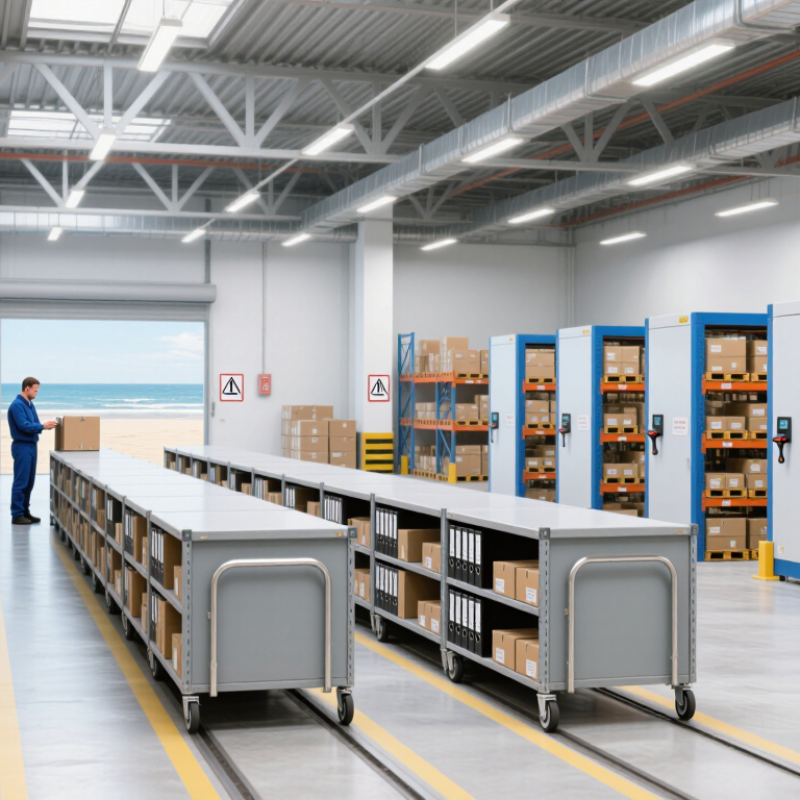
What Mobile Shelving Systems Are and How They Work
Mobile shelving systems are storage units mounted on floor rails. They move sideways, creating one accessible aisle only where needed. This design can use more floor area for stored goods. The principle is simple. Each carriage moves by a handwheel, chain mechanism, or powered motor. Operators select a bay, and the system opens that aisle. Safety sensors stop movement when people or objects enter the travel zone.
A 2024 MHI Annual Industry Report states that 55% of surveyed supply-chain professionals increased technology investment during the previous year. This supports stronger interest in space-efficient storage, but mobile shelving is not automatically the right answer. Facility managers should check floor loading, rail alignment, ceiling clearance, and emergency access before purchase. A loaded carriage may weigh several tonnes. Small installation errors can create uneven movement and costly repairs.
The 2023 Global Warehouse Automation report by Interact Analysis valued the warehouse automation market at more than 20 billion US dollars. Mobile shelving sits between conventional racks and fully automated storage. It can improve storage density without requiring complex software. However, manual systems depend heavily on disciplined operation. Powered versions need electrical protection, access controls, and routine inspections. In practical use, a clear aisle sign and a working stop button matter more than attractive specifications. I would not promise a fixed percentage of space savings, because building shape, inventory size, and safety gaps change the result. A pilot aisle often reveals problems that drawings miss.
Key Factors Global Buyers Should Consider Before Choosing
7 Best Mobile Shelving Systems for Global Buyers
Key Factors Global Buyers Should Consider Before Choosing
A mobile shelving system should fit your building, workflow, and local safety requirements. Measure floor loading, ceiling height, aisle width, and emergency access before comparing prices. A compact aisle is useful, but it can slow picking when several workers need access. This trade-off is often missed.
Load capacity must match real inventory, not an ideal estimate. Check shelf deflection, rail strength, locking devices, and protection against uneven floors. In humid regions, powder coating and corrosion-resistant components may reduce maintenance. In seismic areas, buyers should request anchoring details and engineering documents. Local authorities may also require specific fire-clearance distances.
Technology matters, but it should not become decoration. The 2024 MHI Annual Industry Report found that 55% of supply-chain leaders planned to adopt robotics and automation within one to two years. For mobile shelving, useful options include barcode access, occupancy sensors, and basic inventory integration. Confirm voltage, language settings, cybersecurity controls, and offline operation before ordering. A system that depends on unstable internet can create a painful bottleneck.
Ergonomics deserves direct testing. European Agency for Safety and Health at Work reports that musculoskeletal disorders remain among Europe’s most common work-related health problems. Ask operators to open loaded carriages, reach upper shelves, and move cartons during a pilot. Do not trust a showroom demonstration alone. Request installation training, spare-part availability, warranty response times, and documented load tests. The cheapest quotation may exclude floor preparation, software updates, or future relocation. That is where budgets usually become less predictable.
The chart compares seven widely used mobile shelving configurations by their typical storage-density improvement over conventional fixed shelving. Values represent approximate industry ranges converted to representative midpoints; actual results depend on aisle requirements, load type, building structure, fire codes, and automation level.
Seven Leading Mobile Shelving Systems Compared by Use Case
Mobile shelving is no longer one universal storage answer. The right system depends on access speed, floor area, load weight, and environmental control. The seven leading options are manual compact shelving for archives, hand-crank mobile shelving for offices, electric mobile shelving for libraries, guided-track shelving for warehouses, pallet mobile racking for heavy goods, climate-controlled mobile shelving for museums, and automated mobile storage for high-volume operations.
Manual and hand-crank systems suit records rooms with occasional retrieval. Electric shelving fits libraries where aisle access must remain simple and predictable. Guided-track designs improve warehouse density, but operators need clear travel lanes. Pallet mobile racking handles heavier loads, although floor strength deserves careful checking. Museum storage needs stable temperature and gentle movement. Automated systems offer faster retrieval, yet installation and maintenance costs can rise quickly. A 2024 MHI Annual Industry Report, surveying more than 1,300 supply-chain professionals, found that 55% use robotics and automation or plan to adopt them within two years.
Real projects often reveal a less obvious issue: the densest system may slow daily work. One archive can gain several aisles of capacity, then lose time through poor labeling. The 2023 Global Warehousing Benchmark Report also shows continuing pressure on storage productivity and labor efficiency. Treat those figures as direction, not a promise. Measure retrieval frequency, aisle width, floor loading, fire access, and future expansion before selecting equipment. Small details matter. A quiet motor, visible inventory labels, and manual backup access can prevent expensive interruptions.
Installation, Safety, Maintenance, and Space Optimization
7 Best Mobile Shelving Systems for Global Buyers
Installation, Safety, Maintenance, and Space Optimization
The seven practical options include manual mobile, mechanically assisted, powered, pallet, archive, cantilever, and compact track systems. Selection should follow load weight, floor condition, aisle frequency, and local electrical rules. A powered unit may save labor, but it needs trained operators, emergency stops, and documented inspections. Installation should begin with a level survey, anchor checks, and a clear evacuation route. One missed floor defect can distort an entire row.
Safety deserves measurable attention. The International Labour Organization reported 2.78 million work-related deaths annually in its 2023 global estimate. U.S. OSHA also cites about 36,000 serious forklift injuries each year. Mobile shelving should include anti-tip controls, end barriers, locking brakes, and presence sensors where appropriate. Keep heavy files low. Never treat the rated load as a suggestion. A cautious engineer should verify it again after relocation.
Space optimization comes from measured behavior, not attractive drawings. Map retrieval times, turning zones, fire equipment, and seasonal stock before choosing shelf depth. Compact systems can increase usable storage, but overly narrow aisles may slow picking and create unsafe congestion. Maintenance teams should inspect tracks, wheels, bearings, sensors, and fasteners on a recorded schedule. Dust is small. Damage is not. ISO 45001 guidance supports documented risk controls, worker involvement, and continual review. I would still test one live aisle before approving a full installation; real users often expose problems that software misses.
Global Purchasing, Customization, and Supplier Evaluation Guidelines
7 Best Mobile Shelving Systems for Global Buyers
Global purchasing needs more than a low unit price. According to Grand View Research’s 2024 report, warehouse automation may grow at a 16.7% CAGR through 2030. Mobile shelving fits this shift when it improves floor use and retrieval speed. Buyers should confirm load ratings, rail design, aisle width, seismic conditions, and local fire requirements. A cold warehouse needs different materials than a dry archive.
Customization should begin with real operating details. Measure pallet dimensions, ceiling height, floor tolerance, and daily access frequency. Ask suppliers for load calculations, test certificates, installation drawings, and maintenance schedules. ISO 9001 certification can support process consistency, but it does not prove product quality. Request references from similar climates and building types. Landed cost matters more than the factory quotation. Freight, duties, installation, training, and spare parts can change the final figure sharply. I have seen buyers overlook floor reinforcement. That mistake is expensive.
Tips: Compare at least three suppliers using one specification sheet. Inspect a working installation if possible. Require a written warranty and response-time agreement. Check whether replacement motors, sensors, and rails are locally available. The 2024 MHI Annual Industry Report highlights continuing labor and inventory pressures, so usability deserves equal attention. A beautiful system can still fail when operators avoid it. Feedback from actual users may expose weaknesses that brochures hide.
FAQS
It is shelving mounted on floor rails. Carriages move sideways, opening one usable aisle at a time.
Operators select a storage bay using a handwheel, chain mechanism, or powered motor. Safety sensors can stop movement when people or objects enter.
It can store more goods within the same building area. Actual savings depend on inventory size, aisle widths, building shape, and safety clearances.A drawing can mislead.
Inspect floor loading, rail alignment, ceiling height, anchor points, and emergency routes. A loaded carriage may weigh several tonnes.
Manual systems suit lighter, occasional access. Powered systems suit frequent movement or heavier loads. Pallet, archive, cantilever, and compact-track designs serve different storage patterns.
Use anti-tip controls, end barriers, locking brakes, and presence sensors where suitable. Keep heavy items low and never exceed the rated load.
Powered units may reduce physical effort and improve movement control. They also need trained operators, electrical protection, access controls, and emergency stops.
Inspect rails, wheels, bearings, sensors, fasteners, and brakes on a recorded schedule. Remove dust and investigate uneven movement quickly.Small defects grow.
Yes, a pilot aisle can reveal turning problems, slow retrieval, floor defects, and unsafe congestion. Live users often notice issues that drawings miss.
Conclusion
This guide explains what Mobile Shelving systems are, how their movable bases and track layouts work, and why they can provide greater storage capacity than fixed shelving. It introduces seven leading system types by practical use case, helping global buyers compare options for offices, archives, warehouses, libraries, retail environments, and specialized storage areas. The discussion focuses on load capacity, shelf dimensions, accessibility, floor conditions, operating methods, safety features, space requirements, and the balance between cost and long-term efficiency.
The guide also covers installation planning, user safety, routine maintenance, and space optimization, including aisle management and future expansion. For international purchasing, it outlines how to evaluate suppliers, confirm technical specifications, request customization, assess manufacturing quality, review service capabilities, and coordinate packaging, delivery, and installation requirements. By considering these factors together, buyers can select a reliable Mobile Shelving solution that fits their available space, operational goals, budget, and expected storage demands.

 CrownRacking