Choosing the best Compact Shelving suppliers in China requires more than comparing catalog prices. Buyers must examine engineering quality, production control, service support, and documented performance. The global warehouse automation market continues to expand, according to Mordor Intelligence’s 2024 market analysis. That growth reflects stronger demand for space efficiency, inventory accuracy, and adaptable storage systems. Compact shelving fits this shift, especially in archives, libraries, workshops, and stockrooms with limited floor space.
However, Compact Shelving is not a universal solution. A suitable supplier should calculate floor loading, shelf capacity, aisle clearance, and carriage stability before quoting. ISO 9001 certification can indicate controlled production processes, but it does not guarantee excellent installation or after-sales service. Buyers should also review applicable safety guidance, including EN 15635 for storage equipment inspections and maintenance. The BIFMA industry standards offer useful reference points for furniture durability, although not every shelving product falls directly within their scope.
Look beyond polished photographs. Ask for load-test records, steel thickness, coating specifications, motor protection details, and real project references. A reliable factory should explain how its shelves perform under uneven loads, frequent movement, and humid conditions. It should also provide clear drawings, spare-parts policies, and commissioning instructions. The Freedonia Group’s storage equipment research highlights the continuing importance of modularity and operational efficiency. Still, supplier rankings remain imperfect. Price changes, export experience, and local installation partners can alter the final result. The “best” supplier depends on your building, budget, and risk tolerance. This guide compares Chinese manufacturers through those practical criteria, not marketing claims alone.
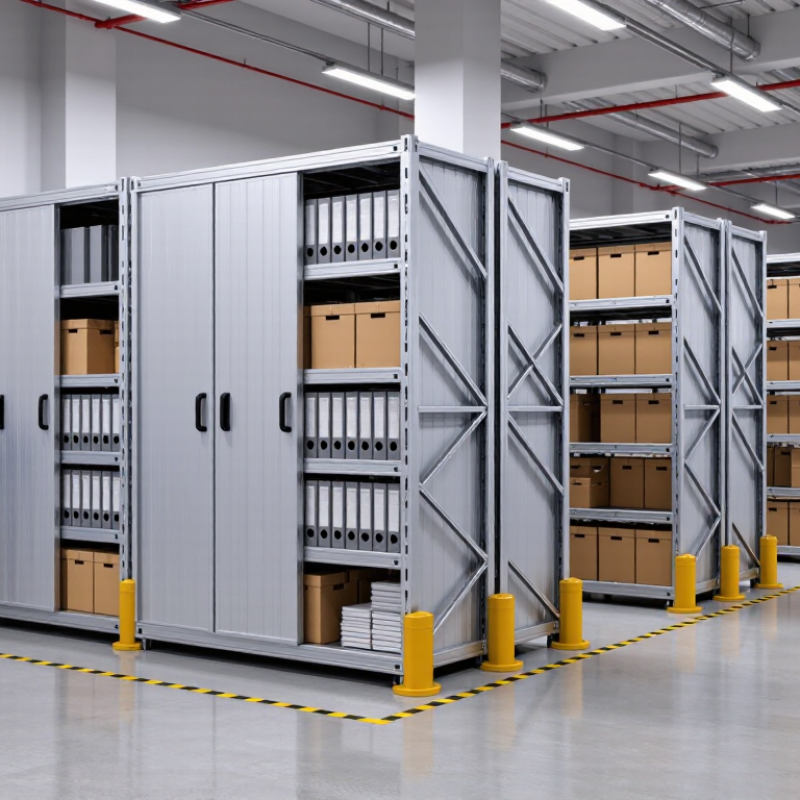
Compact shelving systems use movable carriage units to reduce the number of fixed aisles. Staff open an aisle where needed, often with a hand crank or powered controls. This design can create more storage within the same floor area, but access is less immediate than with static shelving. A busy archive may need frequent aisle movement, so traffic flow matters.
These systems suit archives, libraries, records rooms, and parts storage where items are accessed periodically. Before choosing a layout, check the weight and size of stored materials, floor capacity, ceiling height, and required aisle width. Confirm that the proposed system includes suitable safety stops and emergency access. A compact layout is not automatically better; if several workers need access at once, narrow aisles can slow daily tasks. That trade-off is easy to underestimate.
Tips: Measure actual boxes and leave room for labels. Ask suppliers for rated load data and installation requirements. Test the access plan with staff, not only on a drawing. Small details matter.
How to use this table: This non-branded comparison describes common compact shelving system types and supplier capabilities to assess. Specifications vary by project; request engineered drawings, load calculations, safety documentation, and references before selecting a supplier.
| System or Supplier Capability | How the System Works | Suitable Applications | Typical Configuration | What to Verify with the Supplier |
|---|---|---|---|---|
| Manual mobile shelving | Shelving units run on floor-mounted rails and move by hand using a crank or steering wheel. Aisles open only where needed. | Archives, libraries, records rooms, museums, and offices with controlled access and moderate retrieval frequency. | Multiple mobile carriages, fixed end units, safety stops, and one or more access aisles. Rail layout and shelf dimensions are designed for the available room. | Confirm floor flatness and load capacity, carriage and shelf loads, aisle access, anti-tip measures, end stops, and whether the floor needs a recessed rail or a ramped surface-mounted rail. |
| Mechanically assisted mobile shelving | A mechanical drive reduces the effort required to move loaded carriages. The drive may use a hand wheel or another mechanical arrangement. | High-density storage areas where staff open and close aisles regularly, including libraries, healthcare records rooms, and business archives. | Rail-mounted carriages with a drive mechanism and designated access aisle. The number of carriages and drive arrangement depend on the layout and stored load. | Request the operating-force information, maximum designed carriage load, braking and locking details, emergency access procedure, and maintenance requirements. |
| Electrically powered mobile shelving | Electric motors move the carriages along rails. Controls typically open a selected aisle and may include obstruction detection and emergency-stop functions. | Large or frequently accessed archives, records centers, healthcare facilities, and storage rooms where powered access is appropriate. | Powered mobile bases, control panels, rail tracks, and safety devices. Electrical supply and control configuration must be coordinated with the building. | Check applicable electrical and machinery safety documentation, obstruction protection, emergency stops, manual release, backup or recovery procedures, service coverage, and compatibility with local site requirements. |
| High-density archive shelving | Stationary or mobile shelving uses adjustable shelves to store boxed records and files in a compact footprint. | Government and corporate archives, document storage rooms, and records-management facilities. | Adjustable shelf levels with bay sizes selected for the actual box or file dimensions. Aisle width and storage layout are determined by access and handling needs. | Provide representative box dimensions and weights. Verify shelf load ratings, bay-level loading, labeling options, anchoring requirements, and any fire-protection or building-code constraints. |
| Library and media shelving | Compact shelving combines movable or fixed bays with shelves configured for books, periodicals, or media collections. | Public, academic, and specialist libraries; document collections; and back-of-house collection storage. | Adjustable shelves, book supports where required, end panels, and an aisle plan based on collection format and user access. | Confirm shelf depth and usable clearance for the collection, accessibility and egress provisions, signage, anti-tip design, and compatibility with the library’s cataloging and retrieval workflow. |
| Industrial mobile shelving | Heavy-duty mobile bases support storage shelves or compatible storage modules, consolidating stock while retaining access to a selected aisle. | Parts rooms, maintenance stores, workshops, and other controlled-access areas storing packaged components or supplies. | Rail-mounted bases with shelving dimensions and levels matched to the inventory. The system should be designed around the actual load distribution and handling method. | Ask for documented load calculations for each shelf, bay, and mobile base; confirm anchoring and floor requirements, handling equipment clearances, aisle access, and protection against unintended movement. |
| Supplier engineering and project support | The supplier surveys the site, develops a layout, specifies the system, and coordinates manufacturing, delivery, installation, and commissioning. | Projects with restricted room dimensions, unusual floor conditions, multiple storage formats, or integration with building services. | Typically includes site measurements, layout drawings, a bill of materials, installation planning, and user or maintenance instructions. | Evaluate drawing accuracy, engineering responsibility, quality-control records, installation capability, spare-parts availability, warranty terms, response times, and verifiable project references. |
Request drawings showing shelf dimensions, aisle width, rail placement, and the complete storage layout. Room measurements matter.
Confirm whether capacity applies to each shelf, each bay, or the entire system. Ask for test results matching your exact configuration. Large numbers alone prove little.
Ask for steel thickness, component specifications, coating details, and inspection records. Check reinforced uprights and consistent hole spacing.
Examine a finished unit closely. Look for smooth edges, even coating, stable movement, and clean welds. Compare sample measurements with final drawings.
Specialist metal fabricators may offer more flexible shelf depths and custom dimensions. Integrated factories may coordinate rails and shelves more efficiently. Export-focused suppliers often handle packaging and shipping documents well.
Ask about installation planning, staff training, maintenance, and worn-part replacement. Request realistic production and delivery timelines. Vague support creates trouble later.
Send every supplier the same brief, including room size, item dimensions, and expected loads. Compare written answers side by side. Check freight, installation, and maintenance exclusions.
Yes, if possible, speak with a customer using similar floor space and storage needs. A polished proposal cannot reveal every daily problem. I would still verify the figures independently.
Compact Shelving systems provide a space-efficient way to store and organize goods in warehouses, archives, and other facilities where floor area is limited. By moving storage units along guided tracks, these systems can reduce the number of fixed aisles while keeping stored items accessible. China’s supplier market includes manufacturers with different strengths, from standard shelving production and large-scale fabrication to customized engineering and project installation.
When comparing suppliers, buyers should consider product design, load capacity, materials, manufacturing consistency, customization options, lead times, and after-sales support. It is also important to verify quality controls, relevant certifications, installation expertise, and the supplier’s ability to provide clear documentation and ongoing service. A careful assessment of these factors can help buyers identify a supplier whose Compact Shelving solution fits their space, operational needs, and long-term requirements.

 CrownRacking