China has become a major sourcing destination for modular storage systems, including commercial, industrial, and residential shelving. Global buyers often value competitive pricing, flexible production, and broad customization options. Yet supplier selection requires more than comparing catalog photos or factory quotations.
This guide examines China’s top Modular Shelving manufacturers through practical purchasing criteria. These include material thickness, load-bearing performance, powder-coating quality, connection design, packaging, and production consistency. A reliable manufacturer should explain steel grades, shelf tolerances, testing methods, and expected service life. Buyers should also review samples, factory capabilities, quality-control records, and export experience before placing large orders.
Details matter. A shelf that looks strong may bend under uneven loading. A bright finish may hide weak surface preparation. Sample units can reveal loose joints, sharp edges, or poor carton protection. No supplier is perfect. Even experienced factories may show differences between prototype and mass production. That is why written specifications, pre-shipment inspections, and clear warranty terms remain important.
The strongest manufacturers usually provide engineering support, stable lead times, traceable materials, and responsive communication. However, “top” should not mean the largest or cheapest supplier. It should mean the best fit for a buyer’s application, budget, safety expectations, and market requirements. This article offers a practical framework for comparing Chinese manufacturers with greater confidence and fewer costly surprises.
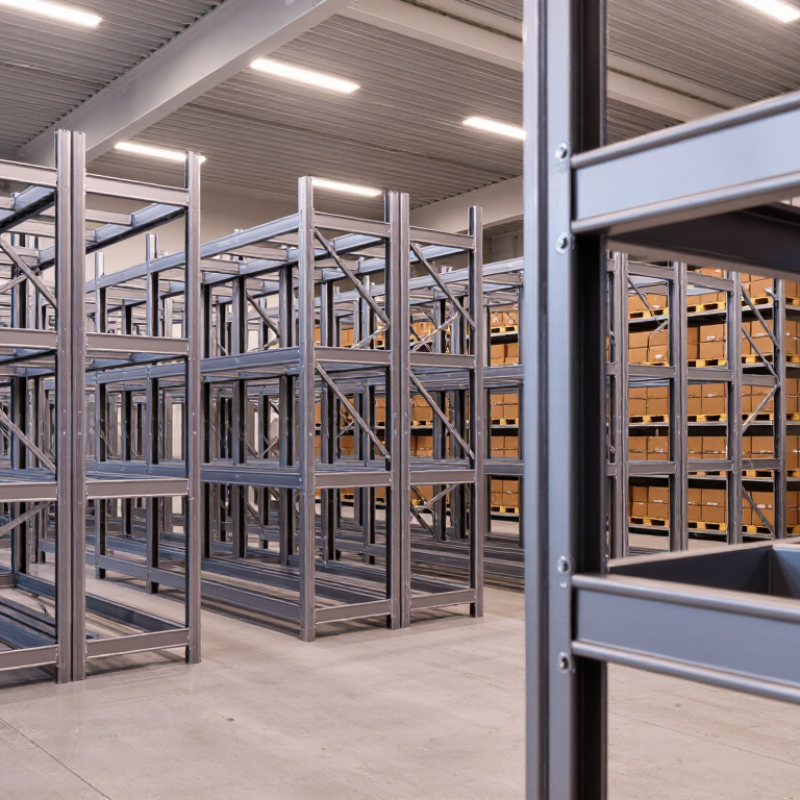
China’s modular shelving market is export-led and highly fragmented. General Administration of Customs data reported China’s furniture exports above US$70 billion in 2023. Shelving is not separately measured, so HS 940320 metal furniture data provides only a practical proxy. UN Comtrade places China among the world’s leading exporters in this category.
The supplier landscape spans metal fabrication, powder coating, panel cutting, and flat-pack assembly. Guangdong and Zhejiang remain important production areas, while Jiangsu and Shandong also support metal furniture supply chains. Many factories offer adjustable bays, boltless frames, warehouse racks, and retail display systems. The differences appear in load testing, weld consistency, packaging design, and replacement-part control.
Professional buyers should compare factory capacity, not only catalog prices. Request test reports, carton dimensions, corrosion-treatment details, and sample assembly videos. SGS and Intertek inspection services can help verify dimensions, coating thickness, and declared load limits. Trade data shows scale, but it does not prove reliability. That is the uncomfortable gap. HS codes also mix unrelated furniture products, making precise market sizing difficult. A supplier with lower output may still provide better engineering support and more stable quality. Buyer audits remain essential.
China’s modular shelving manufacturers serve warehouses, workshops, archives, and retail facilities worldwide. Their engineering quality depends on more than a stated load rating. A typical bay may support 500–1,000 kg, but that capacity requires correct beam spacing, upright geometry, and anchored installation. Steel thickness commonly ranges from 0.5 to 2.0 mm. Thinner steel can reduce cost, yet it demands accurate forming and careful reinforcement.
Experienced buyers should request load tables, section drawings, and test conditions. A 1,000 kg rating may apply only to evenly distributed loads. Concentrated cartons can create dangerous local stress. Inspect the beam connectors, weld consistency, powder coating, and base plates. Ask whether testing follows a recognized method. A catalogue number alone is weak evidence.
In practice, small manufacturing tolerances can affect alignment, especially across long rows. This point is often underestimated.
Tips: Confirm the load per bay, shelf level, and beam pair separately. Check whether the quoted capacity includes safety factors. Request sample sections before placing a large order. Measure aisle clearance after installation, not only on drawings. A 0.5 mm panel may suit light storage, while 1.5–2.0 mm components offer greater stiffness for demanding applications. Do not assume thicker steel always means better performance; design, joints, and installation still matter.
China’s leading modular shelving manufacturers increasingly support global buyers with documented quality systems and specialized production lines. ISO’s 2022 Survey recorded more than 1.26 million ISO 9001 certificates worldwide, showing the standard’s broad acceptance. However, buyers should verify the certificate scope, factory address, expiry date, and covered products. A certificate alone proves little.
For warehouse systems within its scope, EN 15635 guides the use and maintenance of steel storage equipment. It emphasizes loading information, installation checks, damage reporting, and regular inspections.
In practical factory audits, reliable suppliers provide load tables, component traceability, welding records, and assembly instructions. Details matter. Their product specialties may include boltless shelving, long-span units, carton-flow modules, pallet racking, and mezzanine-supported storage. Each requires different testing and engineering controls.
MHI’s 2024 Annual Industry Report found that 55% of respondents were increasing investment in supply-chain technology.
This supports demand for flexible storage that can adapt to changing inventory profiles. Chinese manufacturers can offer useful customization, including adjustable beams, reinforced uprights, galvanized surfaces, and flat-pack export packaging. Yet customization needs discipline. I have seen attractive drawings hide unclear load assumptions and incomplete installation notes. Not enough. Global buyers should request sample inspection reports, independent load testing where necessary, and a clear replacement-parts plan. Production speed is valuable, but documented control is more valuable.
China Top Modular Shelving Manufacturers for Global Buyers?
MOQ, lead time, pricing, and container efficiency often matter more than catalog design. Many export quotations begin around 50–200 sets, but this varies with steel thickness, coating, and automation. A lower MOQ may increase tooling and packaging costs. Ask for a production sample before approving a large order. Small errors multiply quickly.
Lead times commonly range from 25–45 days after drawing approval. Custom colors, reinforced beams, or mixed cartons can add another 7–15 days. The World Bank’s 2023 Logistics Performance Index scored China at 3.7 out of 5 for logistics competence. That supports strong manufacturing coordination, but it does not eliminate port congestion or holiday delays. Request a written schedule with inspection and loading dates.
Pricing should be compared by usable storage capacity, not by unit price alone. A standard 40-foot container provides about 67.7 cubic meters internally, according to ISO container dimensions. Shelving frames waste space when packed fully assembled. Knock-down packing can improve cube utilization, though it may raise assembly labor. A practical loading target is 80–90% of available volume. Perfect utilization is rarely realistic. UNCTAD’s maritime transport reports repeatedly highlight schedule and freight-rate volatility. Therefore, compare FOB and delivered pricing separately, include spare parts, and confirm carton dimensions. One overlooked carton can destroy the calculation.
Comparison of typical export-order benchmarks for MOQ, lead time, unit pricing, and 40HQ container-load efficiency.
The figures represent anonymized planning benchmarks for modular shelving export orders. Unit pricing is indicative USD per shelving bay, while container efficiency is measured as loaded shelving bays per 40HQ container. Final values vary according to steel thickness, coating, packaging, accessories, customization, and destination requirements.
Global buyers evaluating China’s modular shelving manufacturers should begin with ANSI MH16.1 compliance.
This standard addresses industrial and commercial steel shelving design, load capacity, and performance. Ask for stamped drawings, material grades, load tables, and test dates. A supplier’s brochure is not proof. Request independent reports for beam loading, shelf deflection, connection strength, and corrosion resistance. ANSI MH16.1 also does not replace local fire, seismic, or workplace requirements.
Testing must match the final configuration.
Different shelf depths, connectors, and floor conditions can change performance. Factory audits should trace samples from raw steel to packed modules. MHI’s 2024 Annual Industry Report found that 83% of supply chain leaders planned to increase technology investment. That trend raises expectations for accurate inventory and safer storage. Still, digital records can contain errors.
A spreadsheet can lie.
Require serial numbers, calibration certificates, and photographs from witnessed tests.
Incoterms 2020 should define risk clearly.
Under FOB, the buyer normally manages the main ocean freight. Under DAP, the seller arranges delivery, but import clearance may remain with the buyer. Confirm unloading, duties, insurance, and damage claims in writing. Warranty terms should state coverage length, excluded misuse, replacement procedures, and response times. A practical contract may require spare connectors and replacement panels.
The 2023 Global Warehousing Study reported by Peerless Research Group identified labor and space pressures as continuing warehouse concerns. Modular shelving helps, but weak after-sales support can erase its value. Check references from installations operating for at least one year.
A typical bay may support 500–1,000 kg with correct spacing, geometry, and anchoring.
No. Steel commonly ranges from 0.5 to 2.0 mm.
Request load tables, section drawings, material grades, test dates, and stamped engineering drawings.
Shelf depth, connectors, floor conditions, and beam spacing can change performance.
Inspect beam connectors, weld consistency, powder coating, base plates, and upright alignment.
Request independent reports covering beam loading, shelf deflection, connection strength, and corrosion resistance.
State unloading, import clearance, duties, insurance, freight risk, and damage claims in writing.
It should state coverage length, excluded misuse, replacement procedures, and response times.
China’s Modular Shelving industry offers global buyers a broad range of configurable storage solutions for warehouses, factories, retail facilities, and distribution centers. This overview examines the country’s export scale, supplier landscape, and engineering capabilities, including typical bay loads of 500–1,000 kg and steel thicknesses from 0.5–2.0 mm. It also explains how manufacturers differ in quality systems, product specialization, testing processes, and compliance documentation, including ISO 9001 and relevant rack-safety standards.
For international purchasers, the article provides a practical framework for comparing minimum order quantities, lead times, pricing structures, and container-load efficiency. It also highlights essential buyer checks, such as confirming load calculations, independent testing, installation guidance, warranty coverage, and suitable Incoterms. By evaluating these factors together, buyers can identify reliable suppliers, control total procurement costs, and select Modular Shelving systems that match their operational requirements and long-term expansion plans.

CrownRacking