Choosing the right Heavy Duty Racks in 2026 is not simply a matter of buying the strongest steel. It is a decision about load size, product turnover, forklift access, and available floor space. A pallet that fits neatly on paper may still create a daily bottleneck when an aisle is too narrow. Small details matter.
The 2024 MHI Annual Industry Report found that 55% of surveyed supply-chain leaders planned to increase investment in technology and innovation. That figure does not identify a winning rack type, but it highlights a changing operating environment. Selective pallet racks support direct access to many SKUs; drive-in systems increase density for fewer product lines; push-back and pallet-flow racks can help manage deeper storage. Cantilever racks suit long materials, while mezzanines use vertical space. Each option has trade-offs.
MIT professor and supply-chain expert Yossi Sheffi’s work on resilience offers a useful principle: storage design should support reliable product flow, not capacity alone. Treat that as a design lens, not a direct rack specification. The right system depends on actual loads, handling equipment, building conditions, and replenishment patterns. A simple site review can reveal issues a catalog cannot.
There is no universal winner. This guide compares the top heavy-duty rack types for 2026, explains where each performs well, and flags the compromises buyers should examine before choosing. Verify load requirements with qualified rack professionals. Then compare the options against your operation—not just the advertised capacity.
Racking Systems
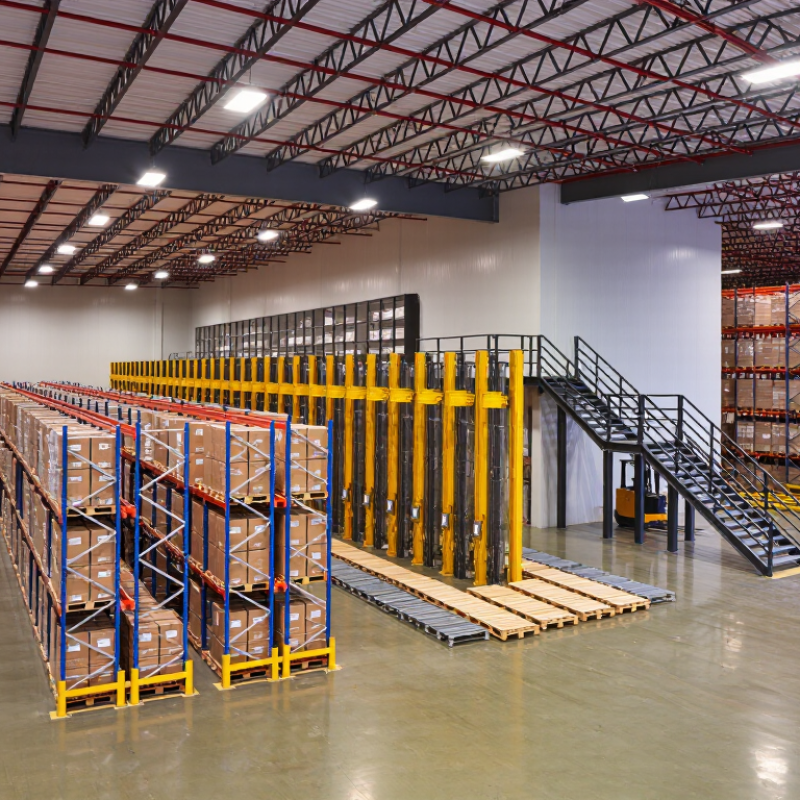
Heavy-duty racking in 2026 is best classified by the loads it holds, access requirements, and operating method. Selective pallet racks provide direct access to each pallet. Drive-in racks store pallets in deep lanes, reducing aisle space but limiting access. Push-back systems use carts on inclined rails, while pallet-flow racks move loads by gravity. These differences affect picking speed and stock rotation. Details matter.
Other types suit different goods and layouts. Cantilever racks hold long items such as pipes or timber, which do not fit neatly on standard beams. Structural rack systems use heavier steel components, while mobile racks move along floor rails to open access aisles when needed. Classification alone does not confirm suitability. Capacity depends on factors like beam span, load distribution, floor condition, and installation quality. A rack that looks robust can still be poorly matched to its loads.
Tips: Check the stated load per beam and per bay, not just the rack’s appearance. Confirm pallet dimensions and forklift clearance on site. Leave room for adjustment; actual inventory may differ from the plan.
Comparing heavy-duty rack types starts with the job, not the steel. Selective pallet racks give direct access to each pallet, but use more aisle space. Drive-in racks store pallets densely and suit fewer product types. Push-back systems improve density while keeping several pallets accessible from each lane. Pallet-flow racks support first-in, first-out rotation, but need compatible pallets and careful maintenance. Measure the aisle. Then check pallet dimensions, load per beam, clear height, forklift reach, and floor capacity. A layout that looks efficient on paper may slow picking in a busy shift.
MHI’s 2024 Annual Industry Report found that 55% of surveyed supply-chain professionals planned to increase technology investment. That points to a practical comparison: will the rack layout work with scanning, automation, or future changes in product mix? OSHA’s material-handling rule also requires stored materials to be secured against sliding or collapse. Real loads matter. Check rack capacities against the actual pallet weight and distribution, not just an average estimate. One caveat: high density can reduce access and make stock checks harder. The best type depends on those trade-offs, plus the building’s clearances and operating routine.
Typical relative ratings for pallet selectivity and storage density
Ratings are an indicative qualitative comparison on a 1–5 scale, not standardized capacity data. Selective racks offer direct access to each pallet; drive-in systems prioritize dense storage, while double-deep, push-back, and pallet-flow systems balance density and access differently. Actual performance depends on layout, pallet dimensions, inventory rotation, and equipment.
Selective and double-deep pallet racks solve different inventory problems. Selective racks give forklifts direct access to every pallet position, making them practical for mixed SKUs and frequent picking. The trade-off is aisle space: each face typically serves one pallet deep, so more aisles may reduce storage density.
Double-deep systems place a second pallet behind the first. They can add positions within the same footprint, but require compatible reach trucks and usually follow last-in, first-out access within each lane. A slow-moving SKU in front can block the one behind. Not ideal for every load. Before specifying, map pallet dimensions, load weights, replenishment patterns, and turning clearances; verify rack capacities and equipment compatibility.
MHI’s 2024 Annual Industry Report, based on nearly 1,000 supply-chain professionals, found that 55% planned to increase investment in supply-chain innovation and technology. That trend does not prove double-deep is better. It does support testing layouts with inventory and movement data, not aisle counts alone. The Rack Manufacturers Institute’s ANSI MH16.1 standard covers steel storage rack design. Have a qualified engineer check loads, anchorage, and seismic criteria. Real sites are messier than clean drawings—and assumptions deserve review.
| Comparison Dimension | Selective Pallet Racking | Double-Deep Pallet Racking |
|---|---|---|
| Pallet storage depth | One pallet deep in each storage position. | Two pallets deep in each storage position. |
| Pallet accessibility | Each pallet can be reached directly from the aisle. | The front pallet must generally be moved before the pallet behind it can be accessed. |
| Selectivity | High: individual pallets are directly accessible. | Lower: access to the rear pallet depends on the front position being clear. |
| Typical handling equipment | Counterbalance or reach trucks, selected to suit aisle width, load, and facility layout. | Typically a double-deep reach truck or another suitable deep-reach handling solution. |
| Storage density | Typically lower than a comparable double-deep layout because each row stores pallets one deep. | Can increase pallet density by storing two pallets deep and reducing the number of access aisles required for a given layout. |
| SKU and inventory fit | Well suited to operations with many SKUs, mixed product, or frequent access to individual pallets. | Best suited to storing multiple pallets of the same SKU or products with predictable rotation. |
| Stock rotation | Supports direct access to individual pallets and flexible picking across locations. | Generally works best with a last-in, first-out access pattern within each two-deep lane; stock rotation rules should be considered in the layout. |
| Picking and replenishment | Direct access can simplify pallet selection and replenishment across a varied inventory. | May require additional pallet moves to reach rear positions, so replenishment and retrieval sequences need planning. |
| Layout considerations | Requires aisle access to each storage face; actual aisle width depends on the truck, load, and building. | Requires deeper storage positions and compatible handling equipment; actual capacity depends on aisle plan, clear height, and load dimensions. |
| Key trade-off | Greater direct access and flexibility, generally with more aisle space per storage position. | More compact storage potential, balanced against reduced selectivity and more specialized handling requirements. |
Planning note: Both systems require a rack design based on the actual pallet dimensions, load weights, building conditions, equipment specifications, and applicable safety requirements. Storage capacity and aisle needs vary by site.
Drive-in racks use deep lanes and allow forklifts to enter the structure. They work well when many pallets share a few SKUs and last-in, first-out access is acceptable.
Push-back systems place pallets on nested carts. Each new pallet pushes the previous one backward, giving operators several pallet positions from one aisle. They are typically used for last-in, first-out storage with more SKU variety than drive-in layouts.
Pallet-flow racks use inclined roller lanes: replenishment happens at the rear, while picking happens at the front. This supports first-in, first-out rotation and can help with dated inventory.
The trade-off is sensitivity to pallet quality and load consistency. A damaged runner or uneven carton load can interrupt flow. Small details matter.
MHI’s 2024 Annual Industry Report found that 88% of surveyed supply-chain professionals expected to increase technology investment over the following five years. That points to growing pressure for better warehouse performance, but it does not prove that higher-density racks are always the answer.
Before choosing a system, measure SKU turnover, pallet dimensions, forklift clearance, and peak replenishment rates. Still, the neat layout drawing can mislead: real pallets are rarely perfectly uniform, and operators need safe access to recover a stalled load.
Cantilever racking stores long, awkward loads such as timber, pipe, and metal sections. Its open front makes picking easier, while adjustable arms can accommodate different lengths. A warehouse team can place long stock directly onto the arms, but each load still needs suitable support and secure placement. The system works best when aisle space and handling equipment match the stored material. It is not automatically the right choice for every long item.
Mobile racking places storage rows on powered or manual bases that move along floor rails. Only one access aisle may be needed at a time, which can increase capacity in a space-constrained building. The trade-off is slower access when another row must move, plus added planning for floor condition, safety controls, and daily workflow. Small operating details matter.
Tips: Measure the longest load, not just the rack. Check floor capacity and aisle clearances with a qualified storage professional. Keep loads within rated limits, and review the layout after real picking shifts. A plan that looks efficient on paper may feel awkward when forklifts turn or staff retrieve stock in a hurry. That deserves a second look.
It gives forklifts direct access to every pallet position. It suits mixed products and frequent picking, but requires more aisle space.
It stores a second pallet behind the first and can add positions within the same footprint. You’ll need compatible reach trucks and should check whether blocked access could slow picking.
It suits warehouses storing many pallets of a few products. Forklifts enter deep lanes, so last-in, first-out access must fit the operation.
Nested carts move pallets backward as new pallets enter. Several positions can share one aisle, with last-in, first-out access.
Inclined rollers move pallets from rear replenishment to front picking. This supports first-in, first-out rotation for dated stock. Pallet quality matters.
Check pallet dimensions, load weights, product turnover, replenishment peaks, and forklift clearances. Small differences can disrupt a neat layout.
Have a qualified engineer review load capacity, anchorage, and seismic requirements. Real warehouse conditions can be messier than the drawings.
No. Surveys reported expected investment in supply-chain technology, but that does not establish which rack suits a site. I’d still question a tidy drawing.
In 2026, Heavy Duty Racks are best understood by how they support, access, and move palletized or oversized loads. Choosing the right system depends on factors such as load capacity, available floor space, inventory turnover, product variety, and the balance between storage density and accessibility. These considerations help businesses match a rack design to their daily operations rather than focusing on capacity alone.
Selective and double-deep pallet racks offer different levels of access and storage density, while drive-in, push-back, and pallet-flow systems are designed to store more inventory within a compact footprint using distinct loading and retrieval methods. Cantilever racks suit long or irregularly shaped items, and mobile racking can increase usable space by moving rack rows as needed. Comparing these types by operational needs can help create a safe, efficient, and adaptable storage layout.

CrownRacking